
IP Phone System Practical notes from Upstate IP Voice - built for real businesses, not legacy telecom systems.
Request DemoIP Phone System
How Long Does It Actually Take to Set Up a New Business Phone Line?
The old way meant a technician, a truck, and a calendar invite you couldn't move. The new way ships ready to plug in.
Ask most business owners how long it takes to add a phone line and you will hear a familiar story. Someone calls the phone vendor. A technician is scheduled. Hardware shows up - or does not. Someone has to unlock the closet, move cables, and hope the configuration survives the visit. Days pass. The new hire is already answering emails without a real extension.
That model was built for a world where every office ran its own on-premise PBX. The equipment lived in a closet. Changes lived with whoever held the keys. Adding a desk was a project. Moving a desk was another project. Opening a second location meant starting over with another box and another calendar hold you could not move.
Upstate IP Voice was built for the opposite reality. Handsets arrive pre-configured. They sync to the cloud when they power on. Adding a line, moving a station, or standing up a temporary desk is measured in minutes - not service tickets. The phone is ready for your account before the box hits the front desk.
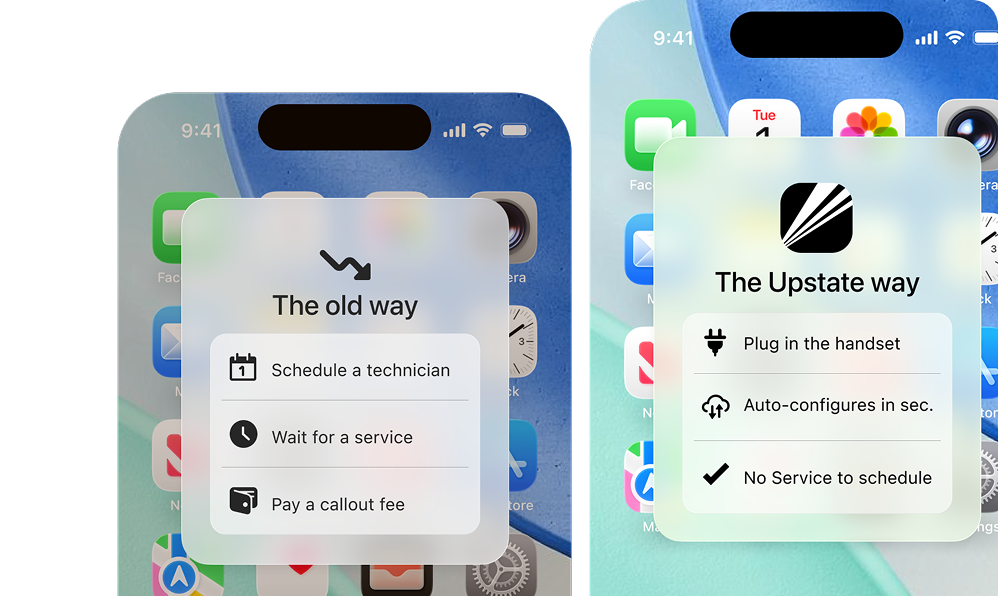
Here is the old way, plainly. You wait for availability. You pay for a truck roll whether the change takes ten minutes or two hours. If the tech cannot finish, you wait again. Meanwhile the new hire is borrowing someone else's extension, or a personal cell is doing double duty as the company line. Customers hear that mismatch even when you try to hide it.
Here is the new way. You order a phone that already knows your account. You plug it into power and network. It pulls its settings from the cloud and joins the same dial plan, voicemail, and call flows your team already uses. No equipment closet. No certification required on your side. No waiting for someone to "program the box" while the floor sits half connected.
That speed matters when growth is uneven. Seasonal staff. A pop-up office. A partner who needs a line for thirty days. A remodel that moves the reception desk twice in one quarter. Legacy systems punish that kind of flexibility with fees and delays. Cloud handsets treat it as normal business, not a special project.
Walk through a real Monday morning. A new associate starts at nine. Under the old model you hope the tech finished Friday, or you hand them a spare handset with yesterday's greeting still on it. Under the new model you place a pre-configured set on the desk, they log into the same system the rest of the team uses, and the first inbound call already knows where to land.
Moves tell the same story. Relocating a station used to mean pulling labels, rewiring, and hoping the closet still had a free port. Now the identity lives in the cloud. The handset is an endpoint. Swap the device, keep the extension, keep the hours, keep the voicemail. The business does not pause while plastic catches up to the org chart.
Reliability follows the same split. An on-premise box is a single point of failure for the floor. If it fails, every desk fails with it. A cloud system distributes the work. A handset can be swapped in minutes. A greeting can be updated from a browser. Your number stays put while the hardware under it changes. That is how real offices stay open when something physical breaks.
None of this means phones stopped mattering. Desk sets still matter for front desks, exam rooms, warehouses, and anyone who lives on speakerphone. What changed is who owns the configuration. The cloud does. The phone is the endpoint - not the entire system. That shift is what turns a two-week install into a plug-in afternoon.
Compare the hidden calendar cost, not only the line fee. Truck rolls burn manager time. Missed windows burn hire ramp-up. Temporary cell forwarding burns professionalism. When setup is measured in minutes, those leaks shrink. You spend the week answering customers instead of chasing a technician's ETA.
If you are comparing quotes, ask one practical question: how long until a new line is live without a technician on site? Ask what happens when you need a second phone next month. Ask who updates the greeting when the lobby moves. If the answer still involves a truck for basic changes, you are buying the old model with a new invoice.
Test the claim the same way you would test a new hire's desk. Order the handset. Plug it in. Confirm it joins the dial plan, rings the right people, and drops voicemail where your team already looks. If that path is clean, setup time is no longer a project plan. It is a packing slip and a power cord.
Upstate IP Voice ships that model - pre-configured hardware, cloud sync, and a setup timeline measured in minutes. When you are ready to see how fast a new line can go live for your floor, look at the IP Phone System on our solutions page or book a quick review. Built for real businesses, not legacy telecom systems.